BFO Shines at Jordan Hall
Boston Festival Orchestra concert review.
The Boston Musical Intelligencer (Classical Scene), July 28, 2026
The Boston Festival Orchestra closed out its 2026 summer-stage season Sunday at Jordan Hall with Mozart’s Sinfonia Concertante for Violin and Viola and Bruckner’s Symphony No. 6. The two Austrian composers are a familiar pairing; usually we get a Mozart piano concerto and a Bruckner symphony. Sunday we got an early Mozart work that we don’t hear often enough and a Bruckner symphony that we hardly hear at all. The performances under Alyssa Wang far exceeded what you might have expected from the very modest ticket prices ($30–$60).
Wang, who’s a violinist and composer as well as a conductor, teamed with clarinettist Nicholas Brown to establish the BFO in 2019 with the goal of providing “more summertime employment opportunities for local professional musicians, more approachable music experiences for classical music newcomers, and more robust music education programs.” The orchestra offers a Chamber Series and Summer Stage concerts as well as collaborating with other local outfits; past presentations have included Beethoven’s Fifth Symphony, Tchaikovsky’s Fifth, Mendelssohn’s Third, Rimsky-Korsakov’s Scheherazade, and Wang’s own Concerto for Violin and Chamber Orchestra. Wang is currently music director of the Cincinnati Ballet and the Cape Symphony Orchestra, but for four years she was assistant conductor at Boston Ballet. I recall hearing her lead the company’s 2024 “Next Generation” program and a program bookended by Balanchine’s choreography for Tchaikovsky’s Mozartiana and Stravinsky’s Symphony in Three Movements.
Mozart wrote K.364 in 1779, while he was on a tour of Europe, for solo violin, solo viola, two oboes, two natural horns, and strings. He could have played either solo instrument himself; he enjoyed taking the viola part in string quartets, and in the Sinfonia Concertante the viola in no way plays second fiddle. The piece is in E-flat, but Mozart wrote the viola part in D and called for the instrument to be tuned up a half step so as to match the bright timbre of the violin. He even wrote the viola section of the orchestra in two parts throughout. One can hear the work as an extended opera duet, the violin as the soprano, the viola as the alto, the two conversing with each other and occasionally joining together, while the orchestra comments on the exchanges. Balanchine used K.364 for his 1945 work Symphonie Concertante; it dropped out of New York City Ballet’s repertoire after 1952 but has since been revived by American Ballet Theatre.
At Jordan Hall, Wang had an appropriately scaled-down string section of 35. I thought she might deploy the first and second violins antiphonally, the normal seating in Mozart’s day, but we got the usual 20th-century arrangement, violins all on the conductor’s left, then the violas, and finally the cellos. She did have distinguished soloists. A professor at the Fryderyk Chopin University of Music in Warsaw, violinist Agata Szymczewska has performed with, among others, Seiji Ozawa, Anne-Sophie Mutter, and Martha Argerich. Teng Li was for six years the principal viola for the Los Angeles Philharmonic and now holds that position with the Chicago Symphony Orchestra.
Sensible tempos prevailed throughout. Wang took the opening Allegro maestoso at a cheerful clip but gave it enough weight to qualify as majestic, and she left ample room for the horns (Nick Auer and Whitacre Hill) and oboes (Catherine Weinfield-Zell and Grace Shryock), pairs that had their own mini-dialogue. The movement could be an opera overture or the beginning of a symphony; it’s Mozart’s little surprise to have the soloists sneak in unannounced. Szymczewska and Li looked somewhere between sheepish and conspiratorial as they entered, the violin with a pleasing astringency, the viola with an autumnal glow. They brought a teasing interplay to the first-movement cadenza and nuanced phrasing to the pulsing Andante, where they could have been Donna Anna and Donna Elvira exchanging grievances in Don Giovanni while the orchestra commiserated. The Presto, at a not-too-presto tempo, was a light-hearted romp, the horns especially robust.
When the soloists returned to take their bow, Szymczewska gave a short speech thanking the international scholarship program Morningside Music Bridge, which had presented MMB alumna Yuja Wang in a special recital earlier this month, and which collaborated with the BFO for Sunday’s concert. Li, who had tuned her viola up a half-step for the Sinfonia Concertante, took the opportunity to retune her instrument, then seemed to ask Szymczewska whether they should play an encore. “I thought we rehearsed some Mozart,” Szymczewska answered. “Let’s do it!” What they did was the slow movement from the First Duo for Violin and Viola, K.423. It was, if anything, even sweeter and richer than the Sinfonia.
The Sixth is Bruckner’s mystery symphony—that is, its unpopularity is a total mystery. At some 55 minutes, it’s among the shortest of his symphonies. He didn’t revise it; there are no textual issues. It’s not a “minor” work like Beethoven’s Fourth or Eighth; Bruckner called it his “cheekiest” symphony. Yet he never heard the entire piece. The two inner movements were given at a Vienna Philharmonic concert in 1883, but it was left to Gustav Mahler to conduct the first performance of all four movements in 1899, three years after the composer’s death, and even then there were abridgments and a degree of reorchestration.
The Sixth didn’t get its premiere from the Boston Symphony Orchestra until 1969, under Erich Leinsdorf, and the BSO has offered it just 10 times. Of all Bruckner’s symphonies, only the First has had fewer BSO performances, and it hasn’t had any. The BSO has never played it at Tanglewood. To the best of my knowledge, Ben Zander and the Boston Philharmonic have never played it anywhere. William Steinberg’s 1970 BSO recording for RCA is one of the BSO’s two (!) Bruckner studio efforts. (The other is Leinsdorf’s 1966 Fourth, also for RCA.) I have fond if distant memories of Leon Kirchner’s 1980s summer performances of the Fifth and Sixth at Harvard’s Sanders Theatre: direct and driving, lean and mean, with a chamber-orchestra intimacy and clarity.
The jacket of the Steinberg LP shows Bruckner’s score floating in the cosmos, the sun above, the moon below, an angel with a horn leaping from the pages. The violins start off with an underpinning two-then-three (the “Bruckner rhythm”) that could be an oscillating signal from outer space; the solemn, Phrygian-mode first theme, in the cellos and basses, suggests God creating the heavens and the earth. Bruckner layers rhythm upon rhythm; he’ll invert a theme and then superimpose that on the original. In the coda of the opening Maestoso, he tonicizes every note of the chromatic scale before finally landing on A major. The Adagio opens with a syncopated oboe figure drawn from bar 15 of the first movement; it’ll return to galvanize the Finale. Bruckner mischievously quotes his own Fifth Symphony in the Trio of the Scherzo; for the Finale’s second theme, he gives us a polka tune, and in the closing pages, he brings back the symphony’s opening “God created the heavens and the earth” theme, as if to say, “And He saw that it was good.”
What tempos to choose for this or any other Bruckner work has become a hot topic. The composer marked the first movement Maestoso; his former pupil Cyrill Hynais, allegedly with the master’s approval, provided an initial metronome mark of 72, which hardly seems majestic and is faster than what conductors are generally comfortable with. The Adagio is marked Sehr feierlich (“Very solemn’), which could mean anything (recordings range from 13 minutes to 22). Ditto for the Nicht schnell (“Not fast”) Scherzo and the Bewegt, doch nicht zu schnell (“With movement, but not too fast”) Finale. The internal tempo markings can be inconsistent or incomplete and are at times puzzling. At the time he was composing the Sixth—between 1879 and 1881—Bruckner was the only conductor likely to perform any of his symphonies, so he didn’t have to be too scrupulous about writing down tempo indications. If he had been able to hear the Sixth and had lived to see it into print, the score might look quite different.
One can take a common-sense approach to all this. Bruckner’s sonata forms—and the Sixth’s first movement, the Adagio, and the Finale are all sonata form—have three theme groups rather than the usual two, and as a rule, the second theme is slower than the first or the third. At least, it should feel that way. Both Steinberg and Otto Klemperer in his 1964 EMI recording with the Philharmonia of London take the entire first movement at virtually the same tempo, but you hear, in the words of my Boston Phoenix colleague Lloyd Schwartz, “one tempo triggering a new one, or ricocheting off the previous one.”
What you hear is, obviously, subjective. I was underwhelmed by Andris Nelsons’s BSO Sixth in 2017. Now, listening to the recording he made with the Leipzig Gewandhaus Orchestra just a year later, I wonder what I was thinking. Even the very slow (19:46) Adagio seems unexceptionable. There are times when I believe there are no bad Bruckner performances, only bad Bruckner critics.
The BFO’s Sixth was not bad at all. It was quick: roughly 14 minutes for the first movement, 16 for the Adagio, 8 for the Scherzo, and 14 for the Finale. The first movement in particular zipped by. Wang made a nice transition to the second theme, let the second section of that theme surge, as it should, and then took the third theme appreciably faster, perhaps having noted the Gemäßigtes Hauptzeitmaß, etwas breit (“Moderated original tempo, somewhat broad”) that appears in the first published edition of the Sixth but not in the “official” Internationale Bruckner Gesellschaft editions of Leopold Nowak and Robert Haas. Hers may well have been the tempos Bruckner had in mind. Still, the maestoso sounded more jaunty than majestic, some detail got lost, and the music didn’t always ebb and flow. The recapitulation ran straight into the coda, the coda’s underpinning strings scarcely registered, and the composer’s molto ritard. three bars from the end got very short shrift. (Whether the music really needs a big finishing ritardando is another matter.)
Balance was the one real problem throughout: the brass tended to overpower the rest of the orchestra, and on occasion, as in the first theme of the Adagio, they were brash when you might have wanted noble. All the same, Wang was rewarding in this movement, the second theme lush and the funereal third stoic rather than self-pitying. She eased out of the development into the recapitulation and then out of the recapitulation into the coda, where the two flutes (Allison Parramore and Hayley Grainger) and solo clarinet (Nicholas Brown) were nothing less than sublime.
Wang’s Scherzo was fast and assaultive; I was left to wonder, if this is Nicht schnell, what would Schnell sound like? Her interpretation of Langsamer (“Slower”) for the Trio, on the other hand, felt natural and just right; a slower Scherzo might have made for a soggier contrasting Trio. (Comparison with Klemperer’s expansive Scherzo suggests there’s more than one way to make Bruckner work.) For the kinetic Finale, Wang observed the composer’s markings, taking the polka at the same tempo as the first theme, eventually slowing and then building toward a faster third theme. The cellos gave the right weary feeling to the development; the coda raced home, Wang making the return of the symphony’s opening theme sound both surprising and inevitable.
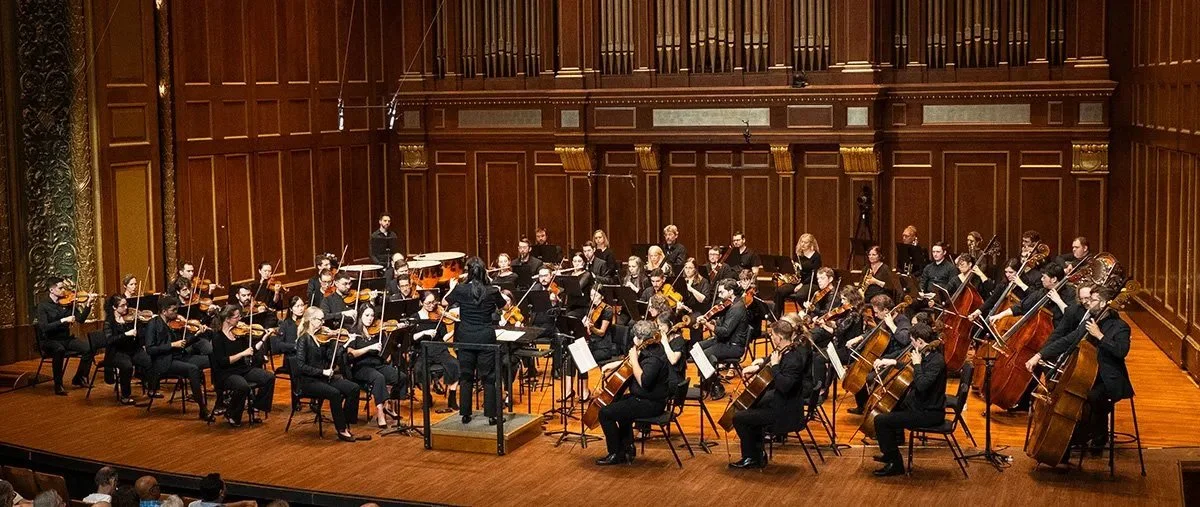
Jordan Hall is perhaps not the ideal venue for any Bruckner symphony, certainly not this one, which may be “short” but is by no means small. (While hesitating to suggest that the Sixth was making its Jordan Hall premiere Sunday, I wonder who would have done it before. Some NEC orchestra?) But Wang drew excellent playing from the orchestra, she maintained the symphony’s rhythmic tension, and for the most part, she put enough air around the composer’s thematic blocks that they didn’t run into one another. And balance was always likely to be problematic with just 42 strings. (The Boston Philharmonic had 62 strings for its 2024 Ninth in Symphony Hall.) This Sixth was also, as she announced from the stage, her first time conducting Bruckner. One can only applaud the extremely creditable result.
Jeffrey Gantz has been writing about music, dance, theater, art, film, and books for the past 45 years, first for the Boston Phoenix and currently for the Boston Globe.